Skip to Content
Le Pic Vert
  • 0
  • 0
  • Sign in
  • NL EN FR
  • Home
  • The scythe
    • The scythe, an efficient tool
    • Quality scythes
    • Our scything guidelines
    • Scything workshops
    • Videos
    • Links
  • Wood
    • My story
    • My hand-tool wood workshop
    • From tree to chair
    • Links
  • Shop
  • Calendar
  • Blog
  • About us/contact
Le Pic Vert
  • 0
  • 0
    • Home
    • The scythe
      • The scythe, an efficient tool
      • Quality scythes
      • Our scything guidelines
      • Scything workshops
      • Videos
      • Links
    • Wood
      • My story
      • My hand-tool wood workshop
      • From tree to chair
      • Links
    • Shop
    • Calendar
    • Blog
    • About us/contact
  • NL EN FR
  • Sign in

Scything workshops

The correct use of the scythe is a learned skill!

​

Indeed, the right movement doesn't seem to come naturally for most people. Often, people who have been mowing for years or even decades have not developed an efficient mowing technique if they have never learned from someone who really masters it. Such experienced people had become very rare in industrialized countries.

Since 2010 I have been teaching scything workshops for groups of 8 people. These workshops cover both theory and practice, covering the following points.

  • The importance of a suitable and ergonomic snath.
  • The correct adjustment of the blade and grips.
  • Understanding the geometry of the cutting edge; a keen edge is essential for comfortable and efficient mowing.
  • Maintaining the blade: peening with the peening anvil, traditional peening with the field anvil and honing with different natural and synthetic stones.
  • How to avoid damaging the blade and how to repair cracks.
  • The principles of comfortable and efficient mowing: the correct movements and techniques, as well as the importance of body posture, relaxation, flexibility and breathing.

A one-day workshop is really the minimum needed to learn how to assemble and use the scythe correctly and how to maintain the edge through peening and honing.

A second day allows you to better understand the gestures of mowing and especially peening, which often requires more practice than mowing itself, and which is nevertheless essential to the proper functioning of the blade.

During the workshops, participants practice and refine their skills with the help of one-on-one advice.

I provide all the necessary equipment for the workshop and I peen the participants' blades in advance so that they can work with the tool at its maximum potential.

If you already have equipment, I suggest you bring it along so that we can assess its potential, as many old blades are of good quality and can be restored.

Workshops are organized throughout the mowing season. Please​ check the calendar regularly or subscribe to our newsletter via the footer to get regular updates as new workshop dates are announced.

If you're interested in organizing a workshop in Belgium, France, or Luxembourg, you'll find more information here.
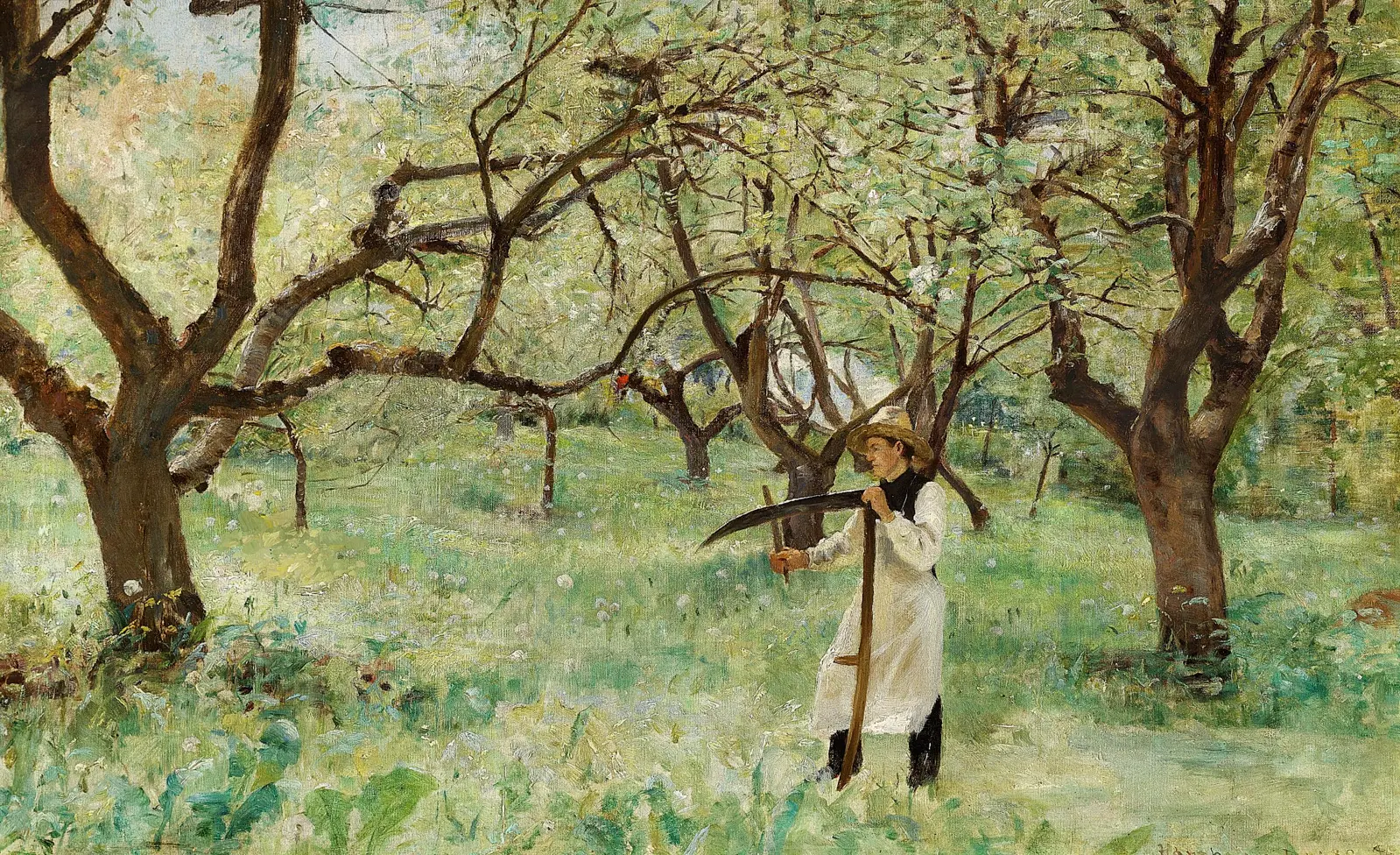
man honing his scytheA young man sharpening his scythe in an orchard, Sigvard Hansen 1888

×


For various internal reasons at Falci, the quality of their blades has recently declined significantly, to the point that in 2024 we had to return several models of blades we had ordered, which is why we no longer offer certain models (or certain lengths of certain models) in our shop.

There has been a deterioration in several blade characteristics, which has a negative impact on their ease of use and their effectiveness.

We hope that Falci will once again be able to produce blades of the excellent quality we have known. We're keeping in touch with them regarding this issue and are closely monitoring the situation.

In the meantime, rest assured, we continue to sell only Falci blades of good, very good, or excellent quality, from previous production runs.

​

×

Mowing grasses and other soft vegetation requires proper maintenance of the blade, which includes peening the edge with an appropriate hammer and peening anvil, and whetting it with a natural whetstone. The whetstone is carried in a whetstone holder on the belt, immersed in water with a bit of vinegar. Adding a small drizzle of vinegar increases the stone's bite and helps keep it clean and functional.


Peening draws out the steel to ensure the correct thinness and geometry of the edge. This operation is done on average after every four hours of mowing, but this time span varies depending on the vegetation, the conditions, the whetstone used, and the mower's technique.


Then, in the meadow, the edge is honed with a whetstone every few minutes, as soon as a little more resistance is felt and/or if the scythe cuts the grass less well.


Frequent peening and honing are essential for proper blade performance!

​

×

Subscribe to the Pic Vert newsletter.

Receive updates about our blog articles, workshop dates, and other events, etc.

​ Merci pour votre inscription !

Subscribe

​

​

        Follow us

Réseaux sociaux

​​

     Share this page

Partager

Subscribe to our newsletter

Contact


© Peter De Schepper     Unless otherwise noted, all photos on this website are our own.

Terms and Conditions    ​Legal notices     Privacy policy     Cookie policy

This website uses cookies to provide a better user experience. Cookies policy

Accept only essential cookies Accept all